
Last updated August 22, 2026. We re-tested Frase hands-on on August 18, 2026 — five article generations on a fresh 7-day trial — after first testing it in May 2026, and ran a further in-app verification pass on August 22 that corrected several feature and trial-limit claims. Pricing re-verified live from frase.io/pricing on August 22 (unchanged). See Testing basis.
This article contains affiliate links; if you buy through them we may earn a commission at no extra cost to you. Full affiliate and editorial disclosures are at the end of this article.
This Frase.io review is built on real testing — running the actual workflow end to end, verifying every citation Frase generated, and pulling pricing straight from Frase’s official page rather than third-party listings or stale 2024 reviews. If you’re deciding whether Frase is worth $49/month in 2026, the answer depends on how you plan to use it.
Bottom line upfront: Frase is worth the $49 Starter plan if you use it the way it’s designed to be used — for SERP research, content briefs, AI Visibility tracking, and SEO + GEO scoring. The Write step produces a fast first draft, but plan to edit it carefully before publishing. Try Frase’s 7-day free trial → (no credit card required).
Is Frase worth it in 2026? Yes — for established bloggers and content teams who want AI to accelerate SEO/GEO research, briefs, and site audits, then edit the draft themselves. Plans start at $39/mo (Starter, annual billing). It’s overkill if all you want is one-click AI articles.
Last verified: August 22, 2026 — pricing and plan features checked same-day against frase.io/pricing. Re-tested hands-on August 18, 2026 (five article generations).
Quick Verdict
If you skim nothing else, take this:
- Best for: Established bloggers and content teams who want AI to accelerate SEO research and brief building, then write or edit the article themselves.
- Skip if: You’re hoping to one-click publish AI-generated articles without editing them. Frase’s article-generation output requires careful review before publication.
- Pricing: $49/month Starter (10 articles, 1 seat), $129/month Professional (40 articles, 3 seats), $299/month Scale (100 articles, 5 seats). 20% off annual billing.
- Free trial: 7 days, no credit card required, capped at 5 articles. Not the full feature set — the limits are a Starter/Professional mix, and internal linking is not reachable on it. Details below.
- Standout features: AI Visibility tracking across the five engines Frase names, gated by tier; SEO + GEO dual scoring; brand-aware content briefs; site audits.
- Main caveat: Internal linking. It is a Professional-tier feature (not included on Starter), and on the trial our August re-test produced no deep links to our own articles across five generations. We’ll explain in detail below.
Frase Pricing in 2026 (Updated)
Frase’s pricing changed significantly in 2025–2026. If you’re reading older reviews quoting $15, $45, or $115 plans, those numbers are out of date. Here’s what Frase actually charges in 2026, verified directly from frase.io/pricing, most recently on August 18, 2026:
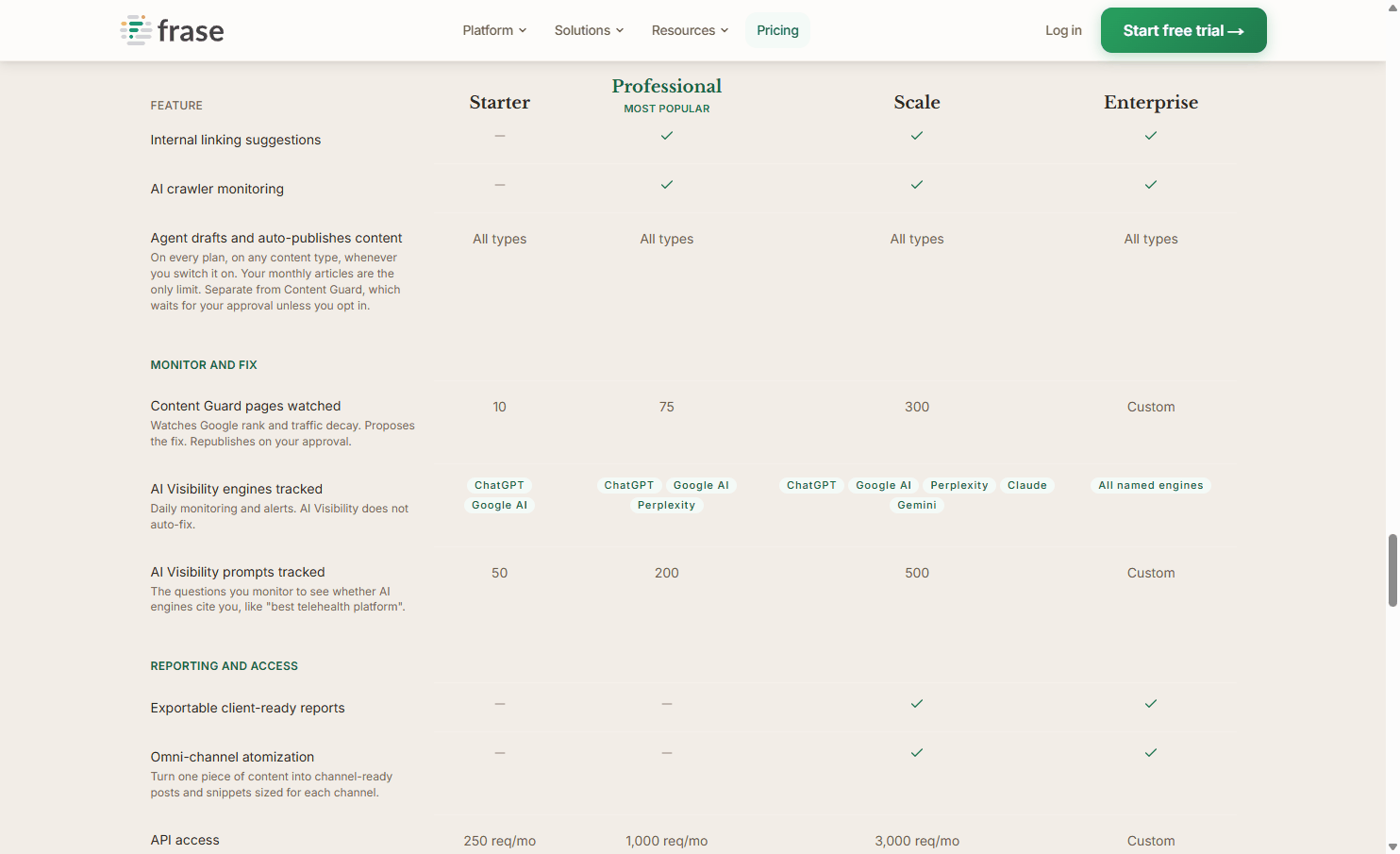
| Plan | Monthly | Annual ($/mo) | Articles/mo | Audit pages/mo | AI Visibility engines | Seats | Best for |
|---|---|---|---|---|---|---|---|
| Free trial | $0 | — | Limited (5) | 50 | — | 3 | 7 days, no credit card, mixed tier limits |
| Starter | $49 | $39 | 10 | 50 | ChatGPT, Google AI | 1 | Solo content creators |
| Professional | $129 | $103 | 40 | 250 | + Perplexity | 3 | Most teams |
| Scale | $299 | $239 | 100 | 1,000 | + Claude, Gemini | 5 | Agencies, high volume |
| Enterprise | Custom | Custom | Custom | Custom | All engines | Custom | Large organizations, SSO, dedicated support |
What changed since older reviews: Plan names changed — the older Solo/Basic/Team tiers are now Starter/Professional/Scale. Prices went up — the entry tier moved from $15 to $49. The volume model changed from “documents per month” to “AI-Optimized Articles per month,” with add-ons available if you need more articles, audit pages, or visibility prompts without upgrading your full plan. The $1-for-5-days trial is gone; the current trial is 7 days free with no credit card.
Add-ons: Extra articles, audit pages, and visibility prompts are purchasable separately. You don’t have to jump from Starter to Professional just because you need 12 articles in a given month.
Extra seats: Professional and Scale include 3 and 5 seats respectively. Additional seats are $29/month each. Solo bloggers can ignore this. For small content teams, $29/seat is on the higher end — Surfer SEO charges $20/seat; NeuronWriter includes unlimited seats on its flat-tier plans.
Trial reality check: The 7-day trial gives you 5 articles, not unlimited — generous against time but capped against volume, at roughly half a Starter month spread across one week. When we tested in May 2026, that cap wasn’t stated anywhere on the pricing page. As of August 18, 2026 it is: Frase’s pricing FAQ now spells the trial quotas out — “Quantities are capped at 5 articles, 50 audit pages, 25 AI prompts and up to 3 seats.” It sits inside a collapsed FAQ rather than on the plan cards, so you still have to go looking, but Frase does disclose it.
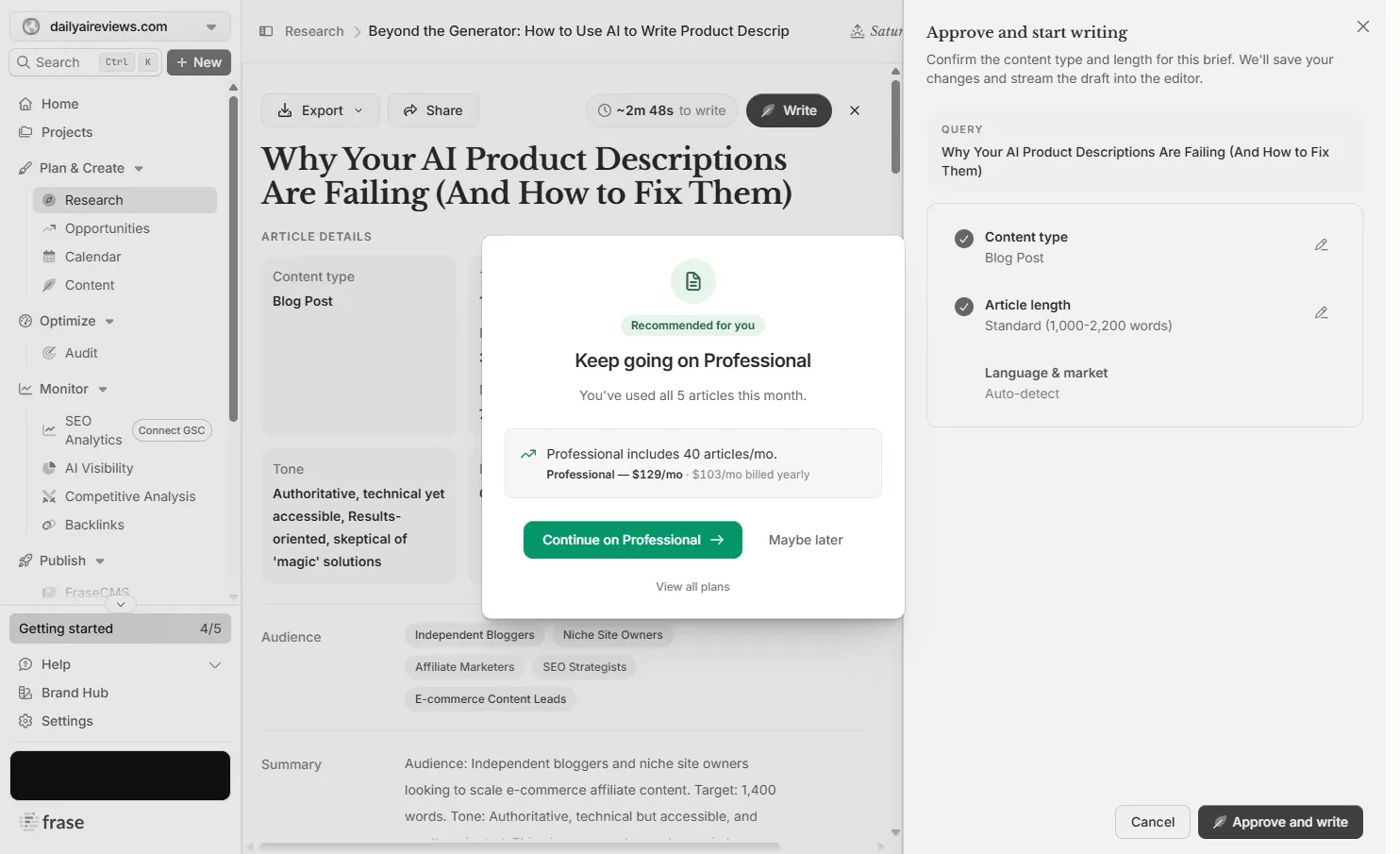
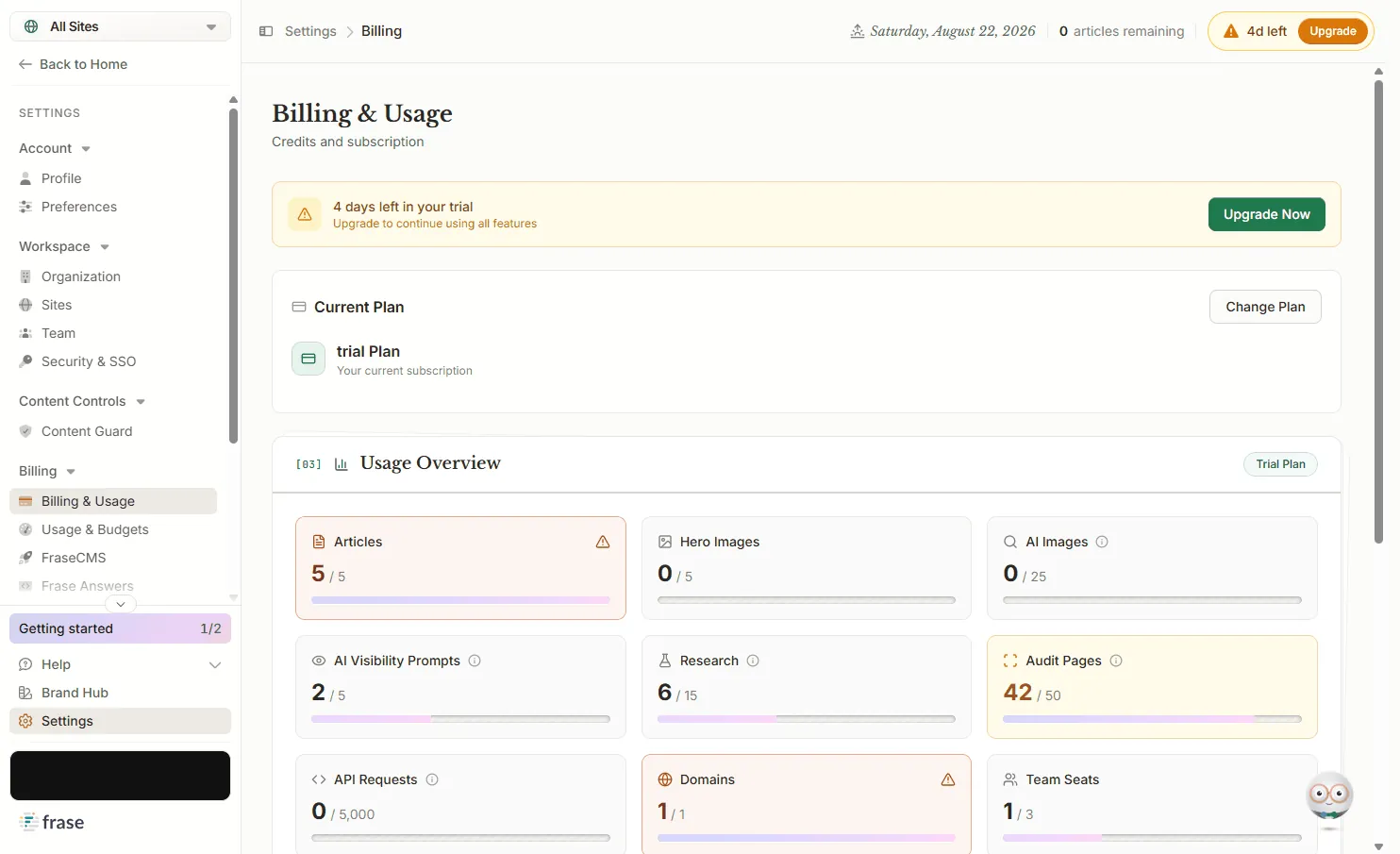
One more trial detail worth knowing. Frase’s FAQ describes the trial as carrying “Professional’s full feature set.” Inside the app on August 18, 2026, our plan was labelled simply “trial Plan,” and its limits were a mix: 3 team seats (matching Professional) but 1 domain and 50 audit pages (matching Starter, where Professional gets 5 domains and 250 audit pages). Budget your trial against those numbers rather than the Professional column.
What Frase Actually Is in 2026
If your last memory of Frase is “SERP research + content brief + AI writer,” the 2026 product is wider than that. Frase has repositioned around what it calls an “agentic SEO and GEO platform.” The shift matters because it changes who Frase is for.
The core writing workflow is still there — keyword in, SERP analysis, brief, AI-generated article — but it sits inside a larger product. The 2026 Frase includes:
- AI Agent — Frase’s name for the drafting engine, presented in-app as writing with your brand in context.
- AI Visibility tracking — citation tracking across the engines Frase names on its pricing page — ChatGPT and Google AI on Starter, Perplexity added on Professional, Claude and Gemini on Scale. You add prompts and Frase tracks how often AI assistants mention your brand. Engine list checked against frase.io on August 22, 2026.
- GEO scoring — Generative Engine Optimization scoring, presented alongside SEO scoring in the editor. Two scores, one for ranking in traditional search and one for being cited by AI answers.
- Site audits — technical SEO crawling with prioritised fix recommendations. We ran a site audit on dailyaireviews.com in both test rounds; the findings view changed between them, which we cover below.
- Content Guard — content monitoring (we did not test this feature in depth during the trial).
- MCP server — read-write MCP integration, so AI agents can directly query Frase’s data and capabilities. Confirm the supported client list against Frase’s own docs before relying on a specific one. Worth flagging for anyone building AI-powered workflows in 2026.
- SEO + GEO dual scoring — real-time scoring built into the content editor, with EEAT (Expertise, Experience, Authoritativeness, Trustworthiness) breakdown alongside the GEO score.
This is a meaningful repositioning. The older “SEO content writer” framing isn’t wrong, but it understates what Frase is doing now. If you’re evaluating Frase for the first time in 2026, you’re looking at a broader SEO platform, not a single-purpose AI writing tool.
What Frase Does Well
The 2026 Frase has genuinely strong features that competitors don’t match. Worth listing them clearly before we get to the caveats.
Internal linking: strong in May, absent in our August re-test
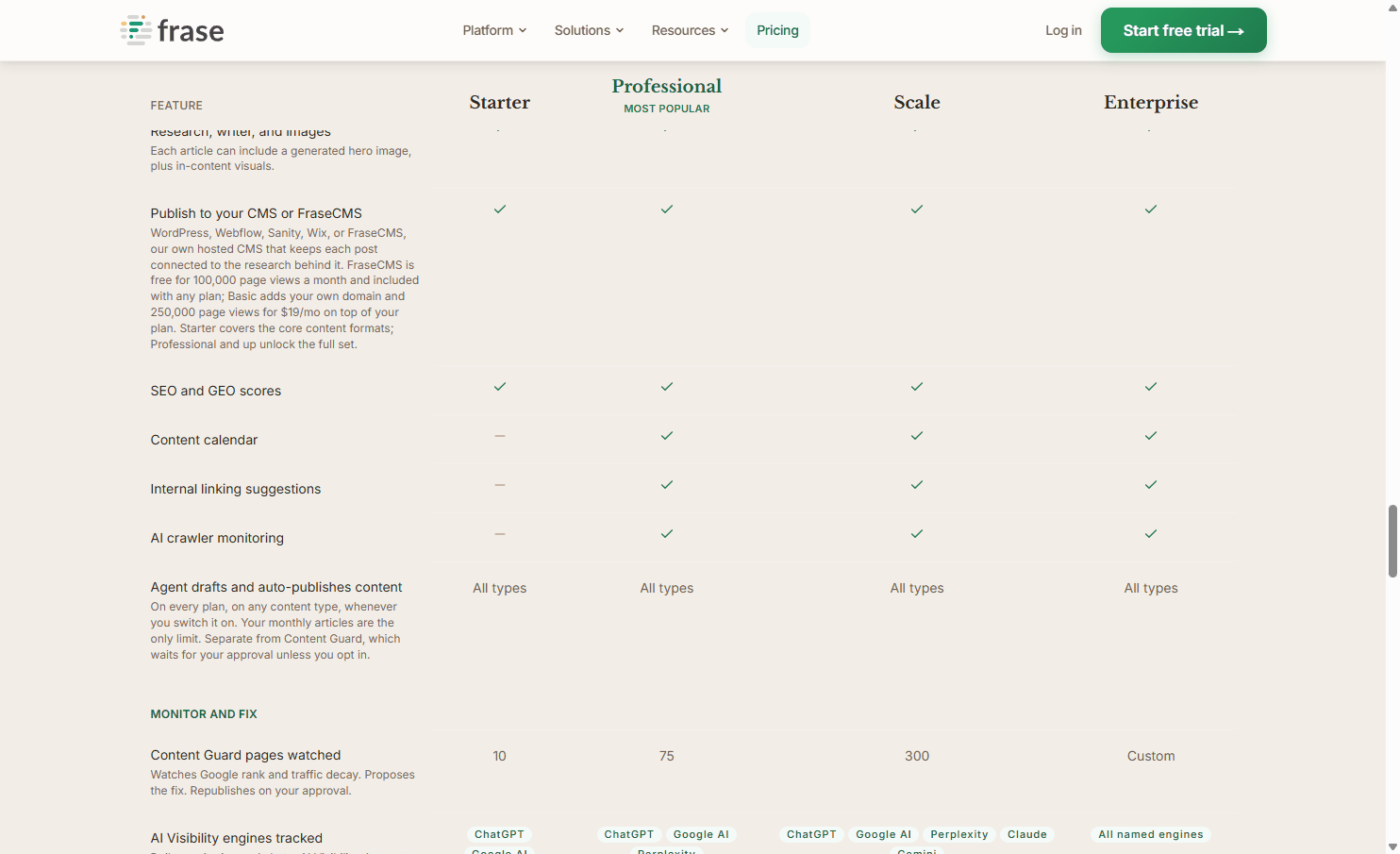
Frase’s onboarding asks for your domain. Behind that input is a crawl that catalogs your existing articles and uses them as internal-link candidates during generation. First, the tier fact: Frase’s pricing table lists “internal linking suggestions” as not included on Starter — the feature starts on Professional ($129/mo).
In our May 2026 test, on the free trial, Frase generated four inline internal links during the Write step, all four pointing to real, topically-relevant articles on dailyaireviews.com:
- /ai-writing-tools-vs-chatgpt/
- /neuronwriter-vs-frase/
- /rytr-review-2026/
- /neuronwriter-review-2026/
Every URL resolved, and every linked article was topically related to the context Frase placed it in. That was May.
In our August 18, 2026 re-test, that did not reproduce. Across five generations on the same free trial — same topic, same default settings — Frase produced no deep links to any of our articles. The only internal link it generated in five runs was a single link to our homepage. For context, Frase’s own documentation says it “targets five to eight internal links per article,” using fewer when they don’t fit naturally.
One prerequisite matters, and Frase documents it: internal linking needs site-audit data, so run the audit before you generate. Completing ours — 30 of our 44 pages scored, including every review and comparison — moved the count from zero to that single homepage link. So audit completeness does affect the result. It did not restore deep linking.
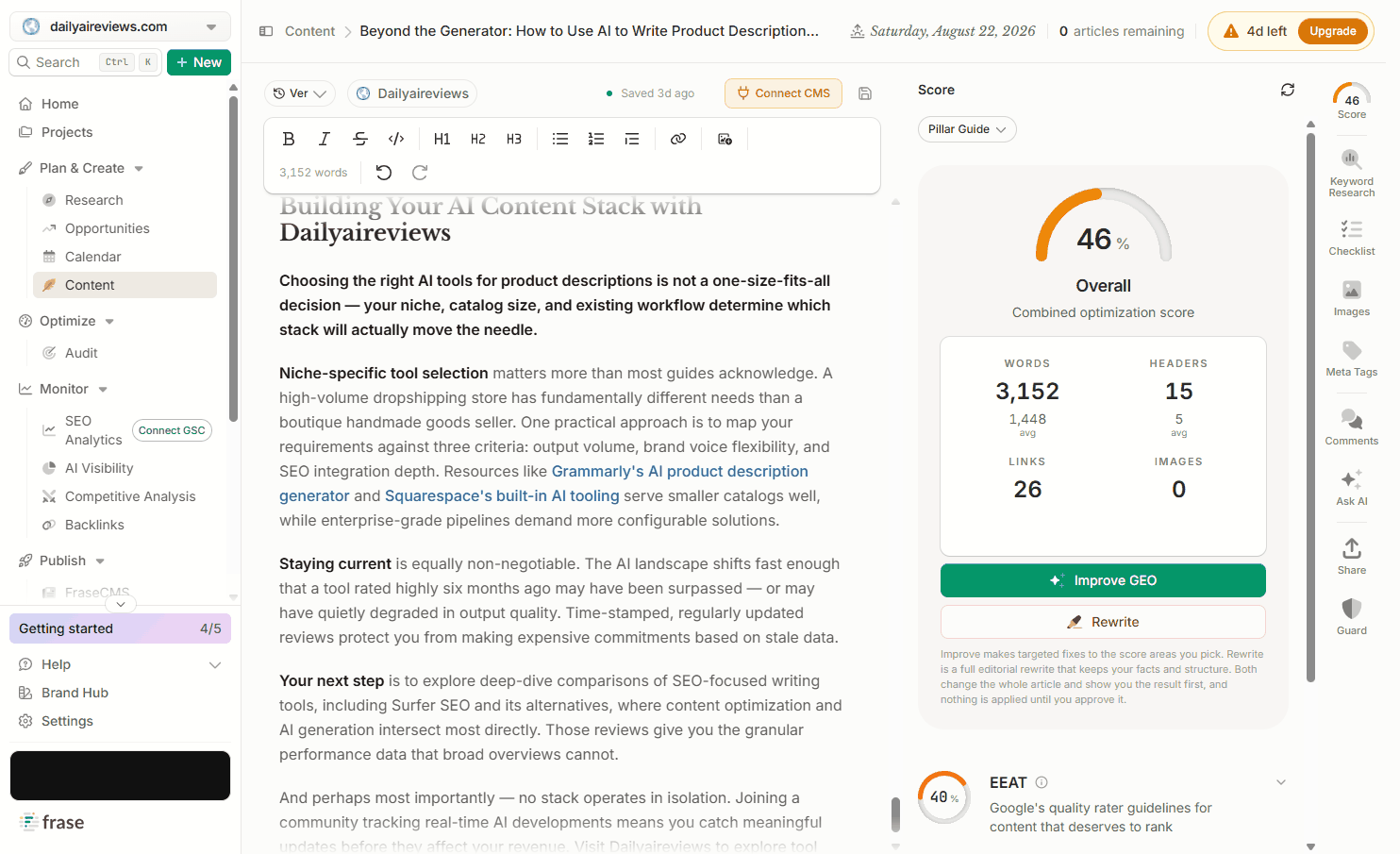
For affiliate review sites internal linking is high-value: it builds page authority, increases dwell time, and surfaces older posts readers wouldn’t otherwise find. On the evidence of our August runs, plan to add those links yourself. Frase’s documentation says the same thing for specific URLs — edit the draft and add them manually before publishing.
Multi-AI-platform GEO research
Frase’s AI Visibility tracking watches the engines it names on its pricing page — ChatGPT, Google AI, Perplexity, Claude and Gemini — for mentions of your brand and your target queries. You add prompts you care about, and Frase tells you when AI assistants are citing you versus your competitors.
This is genuinely new product surface. Frase’s pricing tiers gate how many engines you track — Starter 2, Professional 3, Scale 5. Enterprise is listed only as all named engines, which the pricing table does not enumerate. On Starter that means ChatGPT and Google AI (Perplexity starts on the Professional tier, and Scale adds Claude and Gemini). Frase names the exact platforms each tier tracks on its pricing page, so confirm that list before you rely on a specific engine.
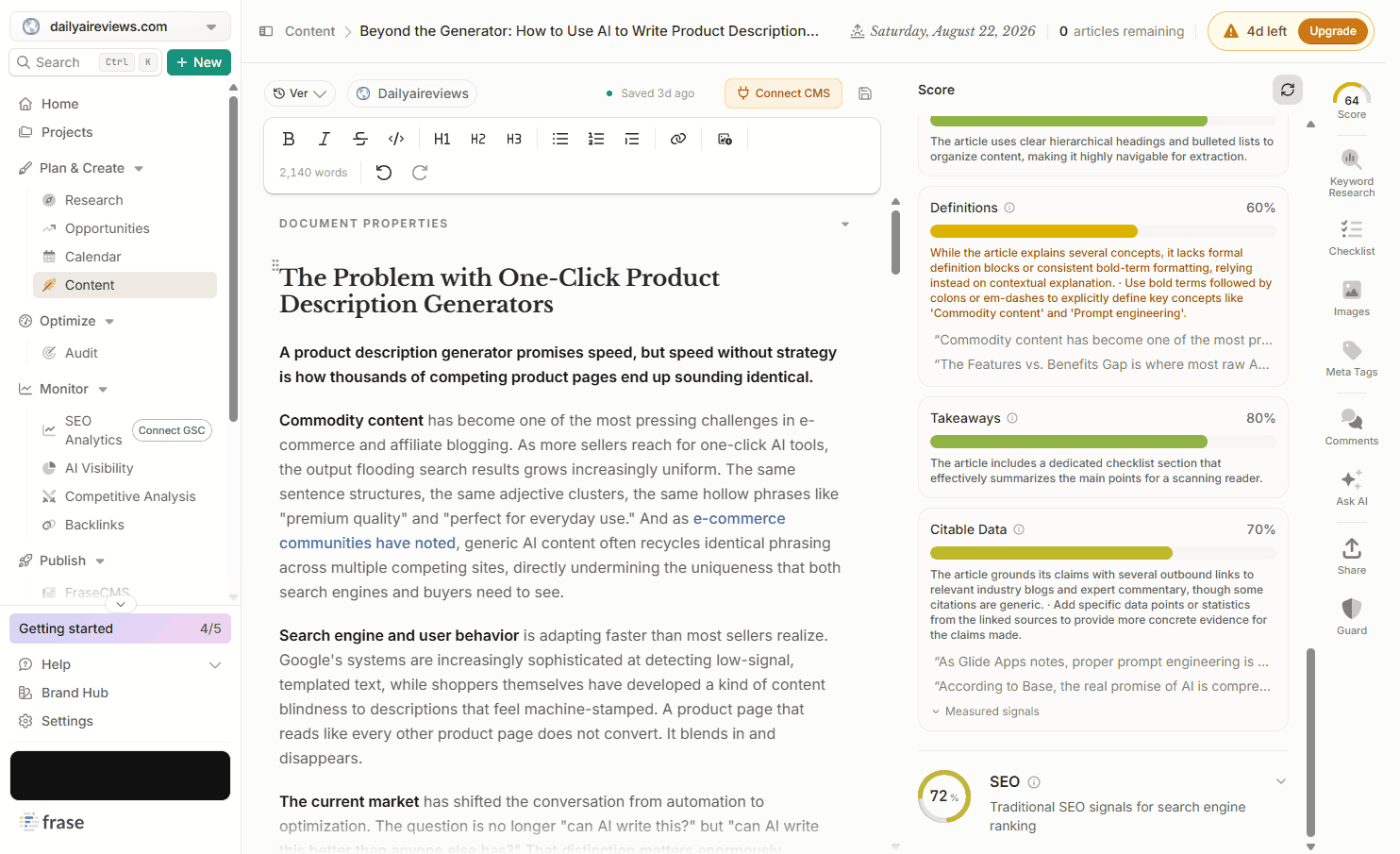
SEO + GEO dual scoring in the editor
The content editor shows two scores in real time: a standard SEO score (with an EEAT breakdown for Expertise, Experience, Authoritativeness, and Trustworthiness) and a separate GEO score for how well the content is structured to be cited by AI answers. Most SEO tools still give you one score. Frase gives you two, and the split matches where SEO is actually heading in 2026.
One caveat we hit in testing: the GEO score’s sub-metrics measure structure more than substance. On an August 2026 generation containing no statistics at all, Frase scored “Citable Data” at 70% and its only remedy was to add more links. Treat the number as a formatting check, not a verification that your claims are actually sourced.
Brand-aware brief generation
In our May 2026 testing, Frase’s Brand Profile analysed dailyaireviews.com in about 90 seconds and produced an accurate classification, including specific phrases like “hands-on testing methodology” that we use to position the site. Re-checked in August 2026 the overview and value proposition still hold, but the Tagline field had been filled with one of our own article titles, and Industry and Notable Projects were left unset — the same empty credential fields Frase’s own E-E-A-T Authority score marks you down for. The brief generated for our test topic reflected that positioning. The article it produced opened with a hook about content treadmill economics, defined a named concept, and used active voice throughout. It read like real content marketing copy, not generic AI output.
This matters more than it sounds. Most AI writing tools produce output that’s voice-flat — same generic tone regardless of who’s writing. Frase’s Brand Profile feature actually shifts the writing to match your positioning. We saw this work.
Workflow speed and editor UX
In our May 2026 testing, the full Write workflow took about 5–6 minutes per article from keyword input to finished draft — slower than Frase’s marketing implies (“under 2 minutes”) but reasonable for what the tool produces. The Brand Profile crawl ran in about 90 seconds and site audits completed in under 5 minutes for 25 pages. We did not re-measure any of these in August 2026, so treat all three as May figures. The interface is modern and the dual SEO/GEO scoring updates smoothly as you edit.
The trial does surface multiple quota counters at once (articles, AI prompts, research queries, audit pages, API requests, hero images), which takes some trial-and-error to understand. The article counter only decremented when we generated a full article — Brand Profile crawls and topic suggestions didn’t consume article quota. We figured this out by watching the counters, not from in-app documentation.
Site audits, and how the findings view changed
In our May 2026 test the audit crawled 25 pages and produced a 68/100 score with 83 issues, and a “Fix Pack” that ranked the top items by projected score gain — Missing H1 (+10), Orphan Page (+9), Missing Canonical Tag (+8), Missing Meta Description (+8), Noindex Detected (+3), a combined 32-point lift.
Re-running the audit on August 22, 2026 gave a different surface: 40 pages, 11 issues, 65% health, with findings ranked by priority, prevalence and fix scope rather than point values — for example “Missing llms.txt, 30 of 30 scored pages, fix once everywhere.” We looked for the point values in three places — the audit overview, the site-wide findings list, and the drill-down on an individual finding — and found no point scores, no Fix Pack and no impact wording in any of them. We still would not tell you Frase has removed the feature: clicking through a finding did not open a dedicated per-page detail view, so there may be a surface we did not reach. What we can say is that it is no longer where it was, so plan around the audit you actually see. Either way, budget against what the audit shows you today.
What the trial actually covers
The 7-day trial covers a lot of the product — Business Analysis, Brand Profile generation, competitor discovery, topic suggestions, SERP research, brief generation, article generation, site audits, AI Visibility tracking. It is not the entire product: internal linking suggestions are a Professional-tier feature and were not reachable on our trial, and the quotas are a Starter/Professional mix rather than Professional throughout.
The Citation Issue: Found in May, Not Reproduced in August
This was the most serious problem we found in May 2026, and it is the main thing our August re-test set out to check. The short answer: we could not reproduce it.
August 18, 2026 re-test. Across five article generations we audited every inline link. Every anchor that named a source resolved to that source’s own domain — 14 of 14, zero mismatches. The fabricated “Daily AI Reviews Internal Testing” citation did not recur. On this evidence, the May problem appears fixed.
Two caveats we would rather state than skip. First, part of the change looks structural: Frase now writes far fewer anchors that name a source at all, so there is simply less opportunity for a name and a link to diverge. Second, in one of the five runs a statistic appeared attributed to a named company with no link at all — verifiable by nobody. Check statistics before you publish.
What we found in May 2026, for the record. What follows is a dated record of the original finding, not a description of how Frase behaves today.
Short version (May 2026): When Frase generated a finished article in the Write step, it inserted confident-looking citations to external authorities — Ahrefs, the Content Marketing Institute, Linearloop, sometimes “internal testing” by your own brand. The visible link text named a source. The actual destination URL often went somewhere else entirely. We clicked every inline link in that article. Here is what we found.
Our test article on “writing product descriptions with AI” contained 11 inline links. We verified each by clicking through and checking whether the destination supported the cited claim.
- “Ahrefs May 2025 study” — the link goes to ranklytics.ai, a Frase competitor SEO platform. The destination page contains no Ahrefs reference, no “4.7x cost ratio” statistic, and no “May 2025 study.” It’s a generic AI product description article authored by Ranklytics’s in-house writer.
- “Content Marketing Institute” — the link goes to uschamber.com, the US Chamber of Commerce’s small business site. The destination article is a competitive review of Jasper, Ahrefs, Hypotenuse, GetGenie, Shopify Magic, and Frase. It contains no “force multiplier” quote and isn’t from CMI.
- “Linearloop retail experiment” (23.7% conversion lift) — the link goes to airops.com, another Frase competitor. The AirOps blog post doesn’t mention Linearloop or the cited statistic. Notable detail: the Brief stage of this same article had identified a real linearloop.io source URL. The Write stage replaced it with the AirOps link.
- “Linearloop production stat” (703 descriptions in 2 hours) — same airops.com URL as the previous citation. The destination doesn’t contain this stat or any reference to Linearloop.
- “Daily AI Reviews Internal Testing” — the link goes to a third-party YouTube video from a product description company. We have never conducted, published, or posted any research called “Daily AI Reviews Internal Testing.” This citation references research that doesn’t exist.
- “Printful blog’s roundup of AI writing tools” — the link goes to a real Printful blog post on AI tools for product descriptions. The article exists and is on topic. The claim attribution is slightly overstated — the source mentions A/B testing only in passing, while Frase frames it as the article’s main point — but the citation is supportable.
- Four internal links to dailyaireviews.com — all four accurate. The internal links worked perfectly (covered in the previous section). Every URL resolved. Every linked article was topically related.
The 11th link was to a second YouTube video we didn’t have time to verify in this session.
So the accounting: 5 external citations where the destination URL doesn’t match the cited source, 1 weak citation with an overstated attribution, 4 accurate internal links, and 1 unverified.
That pattern was consistent across the May test: when Frase sourced external authorities for specific claims in the Write step, the destination URLs frequently didn’t match the named source. In August, across five fresh generations, it did not recur.
Why it mattered. A mismatch like that is invisible at a glance: the reader sees one source named and never checks where the link actually goes. That is why we treat it as the most serious class of finding we can make about a writing tool, and why we re-tested it rather than leaving the original verdict standing.
What Frase says about this. Frase positions the tool as a “Human + AI partnership” and includes a “Take Over” button explicitly designed to hand control back to the writer for editing. Frase isn’t claiming the output is publish-ready — it’s designed to be used with editorial review, including citation verification.
What this means for your workflow. If you’re using Frase as a research and brief tool — generating SERP analysis, building content briefs, scoring your draft for SEO and GEO — this issue doesn’t apply. You’re writing the article yourself, citing your own sources. The Brief stage uses real, verified URLs.
If you’re using Frase to generate full articles and publish them with minimal editing, still check the links and any statistics before publishing — our August runs were clean on links but produced one unsourced statistic. The fastest way to do it: open the article in markdown export, click each external link, and confirm the destination matches the cited source and supports the claim. Plan 10–15 minutes per article for this step.
Used the first way, Frase is genuinely useful. Used the second way, keep a verification pass in your workflow — lighter than it needed to be in May, but not something to skip.
Where Frase Struggles
A few smaller observations worth knowing.
Auto-generated competitor lists need editing
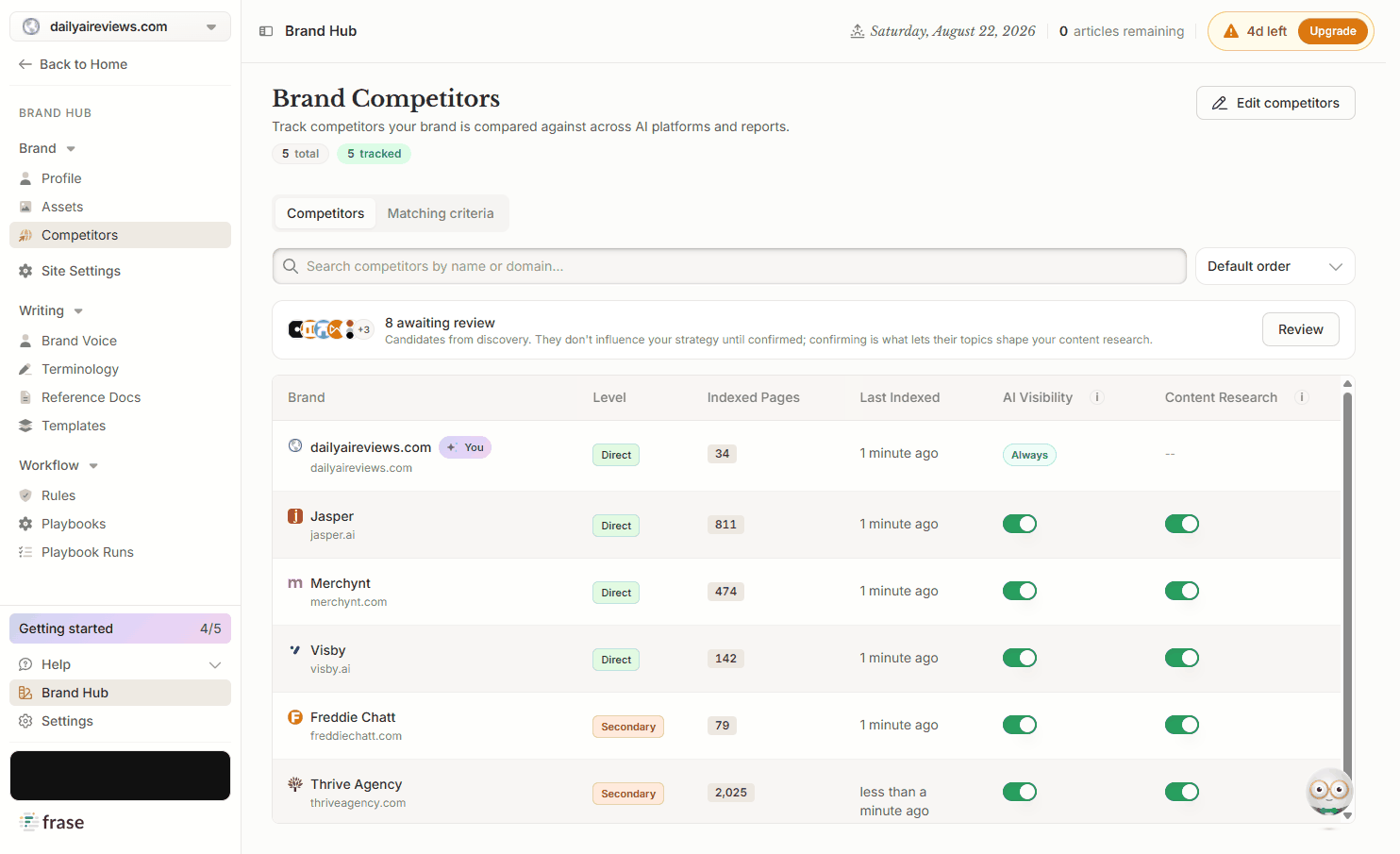
In May 2026 Frase’s Brand Profile generated a 12-entry competitor list for dailyaireviews.com that classified Jasper, Writesonic, Copy.ai, NeuralText and Surfer SEO as “Direct” competitors. These are products we write about, not sites we compete with for traffic. Re-checked on August 22, 2026 the list is 5 tracked plus 8 awaiting review, and of the May set only Jasper remains, still classified Direct. The specific names change; the classification pattern does not. Frase had published its own Competitor Matching Criteria — including the rule that competitors must “primarily generate revenue through referral links to third-party software rather than selling its own proprietary software” — but the auto-generated list violated that exact criterion for 8 of the 12 entries.
The list is editable, but the workflow doesn’t warn you to audit it. A trial user could easily run AI Visibility tracking or competitor analysis against a list that doesn’t reflect actual competitors.
Structural failures in summary sections
In May 2026 the generated article closed with a “Key Takeaways” section that duplicated content from the body and carried a misplaced bullet from a different section. It did not recur: across five generations in August 2026 we found no duplicated takeaway blocks. We are leaving the original finding on the record rather than deleting it, but it is not a current criticism.
Hero images don’t auto-generate
The trial includes 5 hero image credits. We expected Frase to generate cover images as part of the standard article generation flow. It didn’t. Hero images appear to require a separate trigger — they’re not auto-generated during Write despite the quota showing as available. Worth knowing if you’re budgeting time for full article assembly.
Trial quota dimensions are easy to miss (improved since our test)
The trial dashboard exposes a long row of quota counters. Verified in-app on August 22, 2026: Articles (5), Audit Pages (50), Domains (1), Team Seats (3), AI Visibility Prompts (5), Research (15), AI Images (25) and API Requests (5,000). When we tested in May 2026, the public pricing table listed only three of them, so there was no way to tell from outside which limits applied to paid plans. Re-checking on August 18, 2026, that gap has largely closed: the full plan-comparison table now lists Articles, Audit pages, AI generations, AI Visibility prompts tracked, and API access (250 / 1,000 / 3,000 requests per month across Starter, Professional, and Scale). Research queries and hero images still aren’t broken out as their own rows.
Per-seat pricing is on the higher end
$29/seat above the base Professional or Scale plan is higher than Surfer SEO ($20/seat) and meaningfully higher than NeuronWriter’s unlimited-seat model. For solo bloggers this is irrelevant. For small content teams, the math adds up — a 3-person team on Professional is $129 base plus $58 for two additional seats, total $187/month.
Frase vs Alternatives
Quick comparisons for the tools we’ve actually tested.
Frase vs NeuronWriter. NeuronWriter is cheaper ($19/mo entry vs Frase’s $49/mo monthly or $39/mo annual), focused on SEO content scoring and briefs, and includes unlimited seats. Frase is broader — AI Visibility tracking, site audits, GEO scoring, MCP integration. If you want one tool for SEO content workflow and budget is tight, NeuronWriter. If you want AI Visibility tracking and broader SEO platform features, Frase. See our full NeuronWriter vs Frase comparison.
Frase vs Rytr. Different products. Rytr is a template-based AI writer for short-form content — emails, ad copy, blog outlines, social posts. Frase is an SEO platform with an AI writer attached. If you need both short-form AI writing and SEO research, the combined stack is $9 Rytr + $49 Frase Starter = $58 per month. See our full Rytr vs Frase comparison.
Frase vs Surfer SEO. Similar pricing tier, different focus. Surfer leans deeper on SERP analysis and on-page optimization scoring. Frase leans into agentic workflows and AI Visibility tracking. Pick Surfer if your audience still searches Google primarily. Pick Frase if you’re seeing real referral traffic from ChatGPT or Perplexity already, or expect to soon.
Final Verdict
Used as a research and brief tool, Frase is one of the strongest SEO platforms available to bloggers in 2026 — AI Visibility tracking, brand-aware briefs, and impact-weighted site audits in one place. The citation problem we documented in May did not reproduce in our August re-test, which is a real improvement and the biggest change since we first reviewed the tool. What we would no longer promise is internal linking: it is a Professional-tier feature, and on the trial it produced no deep links to our own articles across five August generations.
At $49/month for Starter, Frase is worth it if you’ll use the research and brief stages. If you’d only use it to auto-generate publishable articles without editing, choose a different tool.
Try Frase’s 7-day free trial → (no credit card required). You can explore the full feature set during the trial, including AI Visibility tracking, the Brand Profile workflow, and a site audit on your own domain, before deciding whether the $49/month plan is worth it for your workflow.
Disclosures
Affiliate disclosure: This article contains affiliate links to Frase and other tools. If you sign up or purchase through them, we may earn a commission at no extra cost to you. We only recommend tools we have tested hands-on, and we report what we find — including negative findings.
Corporate relationships: Frase and Rytr — which we also review and recommend — are both part of Copyrytr, the brand collective formed when Copysmith acquired both tools in October 2022. Copysmith is the parent company; Copyrytr is the brand-collective name covering its three products (Copysmith, Frase, Rytr). That doesn’t change the recommendations above — we judge each tool on its own merits — but most Frase reviews online don’t mention it.
Editorial independence: Our verdicts come from hands-on testing, not commissions. Affiliate relationships never influence our rankings or recommendations.
Testing basis: The screenshots in this review are our own, captured from our Frase account during testing on August 22, 2026; account identifiers are redacted. Hands-on testing in mid-May 2026 (sessions on May 14–15 and May 21) and a full re-test on August 18, 2026, both on Frase’s 7-day free trial. The August re-test ran five article generations and four research runs on the same topic used in May, auditing every inline link in every output. Pricing verified from frase.io/pricing on May 14, 2026, and re-verified July 1, August 18 and August 22, 2026 (plans, seats and trial terms unchanged at every check). On August 22 we also re-verified the plan feature table and the in-app trial limits, which corrected several claims in this review: the AI Visibility engine list, the “80+ skills” and MCP client claims, the site-audit findings view, the trial quota counters, and the competitor-list example.
What changed at the August re-test: the citation-mismatch finding did not reproduce — 14 of 14 source-naming anchors resolved correctly across five generations — so the original verdict has been revised rather than repeated. We re-run each reviewed tool’s output test every 90 days; this one came due in August 2026 and ran on August 18. Internal linking moved the other way: four accurate deep links in May, none across five generations in August. Not everything was re-tested — we did not exercise the configured-user path with reference documents attached, the Google Search Console keyword-linking option, or Content Guard. Both rounds ran on the free trial, so we cannot rule out that Frase re-scoped the trial itself between May and August.
Frequently Asked Questions
Is Frase free?
No standalone free plan. Frase offers a 7-day free trial with no credit card required, capped at 5 articles during the trial. It is not the full feature set: the trial limits mix Starter and Professional tiers, and internal linking suggestions are not reachable on it. After the trial, plans start at $39/month for Starter on annual billing or $49/month monthly. For a day-by-day breakdown of what the trial actually includes, see our Frase free trial guide.
Is Frase worth $49/month?
Yes if you’ll use it for SERP research, brief building, AI Visibility tracking, or site audits. The Brand Profile and Brief stages alone justify the price for many bloggers. If you only plan to use it for AI article generation, the price is harder to justify at $49/mo — NeuronWriter at $19/mo covers similar ground for that specific use case.
Does Frase replace a content writer?
No. Frase’s own marketing positions the tool as a “Human + AI partnership.” The Write step produces a fast first draft that requires editing before publication, including checking any external citations Frase inserts.
Who owns Frase?
Frase is owned by Copysmith, which acquired both Frase and Rytr in October 2022 and launched Copyrytr as a brand collective housing all three tools. Copysmith is the parent company.
What’s new in Frase for 2026?
Major repositioning around agentic SEO and GEO: an AI Agent drafting layer, AI Visibility tracking across the five engines Frase names (ChatGPT, Google AI, Perplexity, Claude and Gemini, gated by tier), GEO scoring alongside SEO scoring, site audits, Content Guard, and an MCP server. Verified against frase.io on August 22, 2026.
Does Frase have a money-back guarantee?
The 7-day free trial is the primary risk-mitigation mechanism. Beyond that, refund policy isn’t prominently advertised on the public pricing page. Contact Frase support before subscribing if a refund policy matters to you.
Can I use Frase with WordPress?
Frase has CMS publishing integrations including WordPress. We didn’t test the WordPress publishing flow during this review. If direct WordPress publishing is important to your workflow, verify the integration during your 7-day trial.