This article contains affiliate links; if you buy through them we may earn a commission at no extra cost to you. Full affiliate and editorial disclosures are at the end of this article.
ChatGPT changed everything when it launched. Suddenly anyone could generate text, answer questions, and draft content in seconds. So why would a blogger pay for a dedicated AI writing tool when ChatGPT exists — and has a free version?
It’s a fair question. In this AI writing tools vs ChatGPT comparison I’ll give you an honest answer based on actually using both for blog content creation. By the end you’ll know exactly which option belongs in your workflow — and whether you need both.
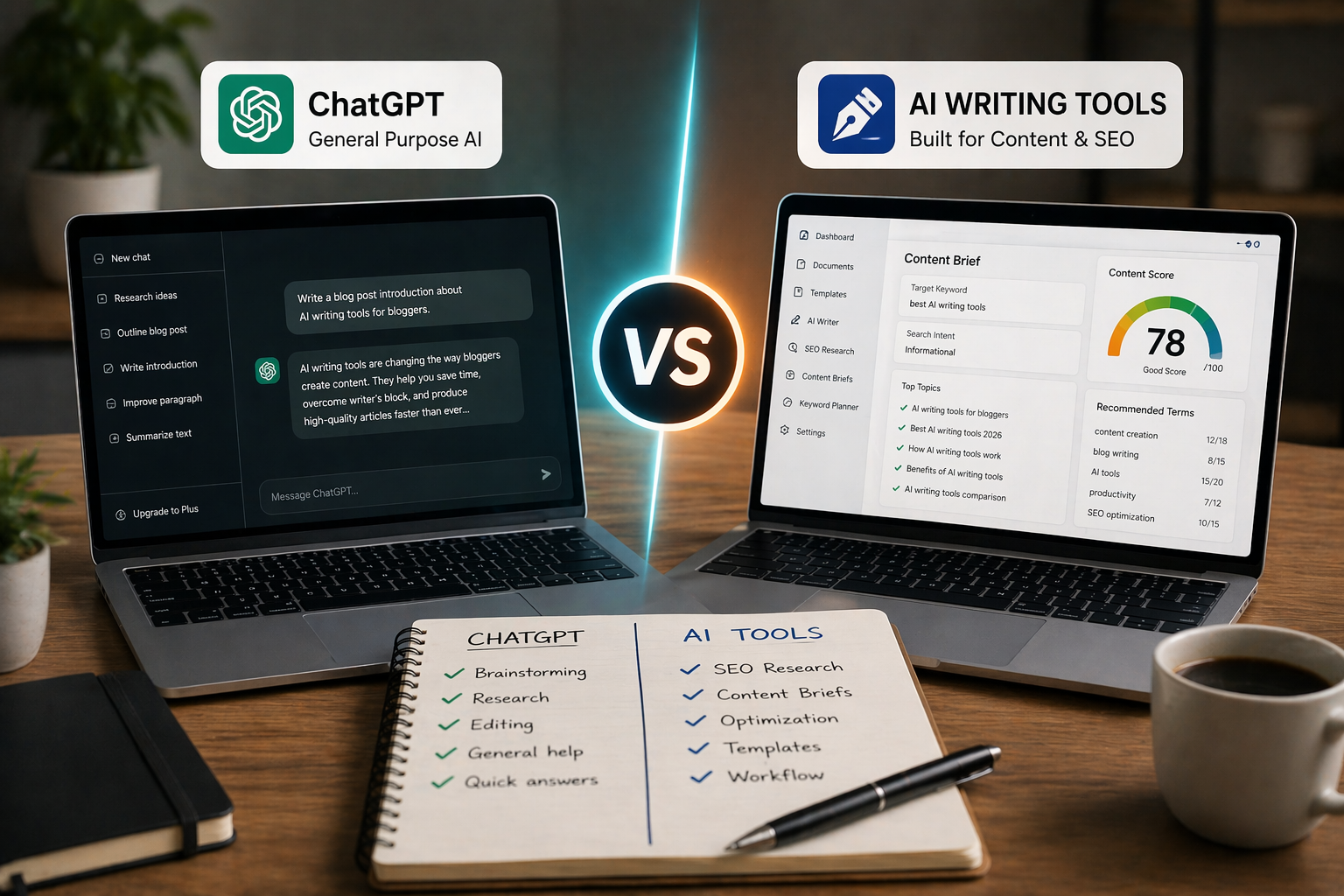
Bottom line upfront: ChatGPT is a powerful general purpose AI assistant. Dedicated AI writing tools like Rytr, Frase.io, and NeuronWriter are built specifically for content creation and SEO. For most bloggers the right answer is to use both — for different things.
AI Writing Tools vs ChatGPT: The Quick Comparison
| ChatGPT | Dedicated AI Writing Tools | |
|---|---|---|
| Primary purpose | General purpose AI assistant | Content creation and SEO |
| SEO research | None | Built-in (Frase, NeuronWriter) |
| Content templates | None — prompt from scratch | 40+ pre-built templates |
| Keyword optimization | Manual — you must prompt for it | Automatic scoring and suggestions |
| Learning curve | High — requires prompt engineering | Low — guided workflows |
| Free plan | Yes — generous | Yes — varies by tool |
| Best for bloggers | Research, brainstorming, editing | Drafting, SEO, publishing workflow |
What Is ChatGPT and What Is It Actually Good At?
ChatGPT is a large language model built by OpenAI. It’s designed as a general purpose conversational AI — you can ask it almost anything and get a detailed, coherent response. For bloggers it’s genuinely useful for:
- Topic research — getting a quick overview of any subject before writing
- Brainstorming — generating article ideas, headline variations, and angles
- Editing and rewriting — paste your draft and ask it to improve specific sections
- Answering reader questions — understanding what your audience wants to know
- Creating prompts — generating better prompts for other AI tools
Where ChatGPT falls short for bloggers is everything around the writing workflow itself — SEO research, keyword optimization, content briefs, template-driven drafting, and direct WordPress integration. It can do some of these things if you prompt it carefully, but it requires significant manual effort compared to dedicated tools.
What Are Dedicated AI Writing Tools and What Makes Them Different?
Dedicated AI writing tools are built specifically for content creators. They use similar underlying language models to ChatGPT but wrap them in workflows, templates, and integrations designed around the blogging process.
The key differences from ChatGPT:
Pre-built templates eliminate prompt engineering
With ChatGPT you need to write detailed prompts to get useful output. With a tool like Rytr you just select a template — Blog Post Outline, Blog Section Writing, Meta Description — fill in a few fields, and hit generate. No prompt writing required. This makes dedicated tools significantly more accessible for bloggers who aren’t AI power users.
SEO research is built in
ChatGPT has no access to real-time search data. It can’t tell you what’s currently ranking for a keyword or what topics the top pages cover. Tools like Frase.io and NeuronWriter analyze live Google search results and build content briefs based on what’s actually ranking today. That’s a fundamental capability ChatGPT simply doesn’t have.
Content scoring tells you when to stop writing
Frase.io and NeuronWriter give you a real-time content score as you write — showing how thoroughly your article covers a topic compared to competitors. ChatGPT has no equivalent. You’d have to manually research competitors, manually identify gaps, and manually check your own coverage. Dedicated tools automate this entire process.
Workflow integration saves time
Dedicated AI writing tools are built to fit into a publishing workflow — they connect to WordPress, save your documents, track your content history, and let you manage multiple articles in one place. ChatGPT is a chat interface. Every conversation starts fresh with no memory of previous sessions and no integration with your publishing platform.
AI Writing Tools vs ChatGPT: Head to Head on What Matters for Bloggers
Writing Quality
On raw writing quality ChatGPT is genuinely impressive — often better than dedicated tools on a sentence-by-sentence basis. It produces more natural, varied prose when given good prompts. Dedicated tools like Rytr produce slightly more formulaic output but with far less prompt effort required.
Winner: ChatGPT — but only if you know how to prompt it well.
SEO Optimization
This isn’t close. ChatGPT has no live search data, no SERP analysis, no content scoring, and no competitor research. Frase.io and NeuronWriter are purpose-built for exactly this. If ranking on Google is your goal, dedicated SEO writing tools are essential.
Winner: Dedicated tools — by a wide margin.
Ease of Use for Beginners
ChatGPT requires you to learn prompt engineering to get good results. Vague prompts produce vague output. Dedicated tools like Rytr have guided templates that produce useful output even for complete beginners. You don’t need to know how to write a good prompt — just fill in the fields.
Winner: Dedicated tools.
Versatility
ChatGPT can do almost anything — write code, answer complex questions, translate languages, summarize documents, and much more. Dedicated AI writing tools are specialized for content creation and don’t try to do everything else.
Winner: ChatGPT.
Cost
ChatGPT free tier is generous and ChatGPT Plus is $20/month for significantly more capability. Rytr starts at $9/month, Frase.io at $49/month, NeuronWriter at $19/month. For a blogger using multiple dedicated tools the cost adds up faster than a single ChatGPT subscription.
Winner: ChatGPT on pure cost.
Publishing Workflow Integration
Dedicated tools save your work, integrate with WordPress, and are built around a publishing workflow. ChatGPT is a chat interface — everything starts fresh each session with no memory, no document management, and no direct publishing integration.
Winner: Dedicated tools.
The Real Answer: You Don’t Have to Choose
The most productive bloggers in 2026 aren’t choosing between AI writing tools and ChatGPT — they’re using both for different parts of their workflow.
Here’s how they fit together:
| Task | Best Tool | Why |
|---|---|---|
| Topic research and brainstorming | ChatGPT | Fast, conversational, no setup |
| Keyword research and SERP analysis | Frase.io or NeuronWriter | Live search data ChatGPT can’t access |
| Article outline generation | Rytr | Templates faster than prompting ChatGPT |
| Section drafting | Rytr or ChatGPT | Either works — Rytr faster, ChatGPT more flexible |
| SEO optimization and scoring | Frase.io or NeuronWriter | ChatGPT has no equivalent feature |
| Editing and improving drafts | ChatGPT | Better at nuanced rewriting |
| Meta descriptions and titles | Rytr | Dedicated template, faster than ChatGPT |
Which Should You Start With?
If you’re completely new to AI tools: Start with ChatGPT free to understand what AI-generated content looks and feels like. Use it for a week to get comfortable with the concept. Then add Rytr’s free plan when you’re ready for a workflow built specifically around blogging.
If you’re already using ChatGPT for blogging: Add a dedicated AI writing tool now. You’re leaving significant SEO capability and workflow efficiency on the table by relying on ChatGPT alone. Start with Rytr for faster drafting and add Frase.io or NeuronWriter when SEO becomes a priority.
If you’re on a tight budget: Use ChatGPT free + Rytr free plan together. That combination costs $0 and covers the full blogging workflow adequately for getting started.
AI Writing Tools vs ChatGPT: The Honest Verdict
ChatGPT is an impressive general purpose tool that every blogger should have in their toolkit. But it was not designed for the specific workflow challenges bloggers face — SEO research, keyword optimization, content briefs, and publishing workflow integration.
Dedicated AI writing tools fill those gaps. They’re not smarter than ChatGPT — they’re more specialized. And for bloggers who publish regularly and care about search rankings, that specialization is worth paying for.
The answer to AI writing tools vs ChatGPT isn’t either/or. It’s both — used for the right tasks.
Start here: Try Rytr free → | Try Frase.io free for 7 days → | Try NeuronWriter free →
More AI Tool Guides and Reviews
- AI Writing Tools for Beginners: Complete Guide
- Best AI Writing Tools for Bloggers in 2026
- Best Free AI Writing Tools in 2026
- How to Write a Blog Post Faster with AI Tools
- Rytr Review 2026 — Full Breakdown
- Frase.io Review 2026 — Full Breakdown
- NeuronWriter Review 2026 — Full Breakdown
Frequently Asked Questions
Is ChatGPT better than AI writing tools for bloggers?
Not overall — they’re better at different things. ChatGPT produces more flexible, natural prose and excels at research and editing. Dedicated AI writing tools are better for SEO optimization, guided drafting workflows, and publishing integration. Most productive bloggers use both.
Can I use ChatGPT instead of Rytr or Frase.io?
You can use ChatGPT for drafting instead of Rytr — the output quality is comparable if you write good prompts. But you can’t replace Frase.io or NeuronWriter with ChatGPT because those tools access live Google search data that ChatGPT doesn’t have.
Is ChatGPT free?
Yes — ChatGPT has a generous free tier. ChatGPT Plus costs $20/month for faster responses and access to more advanced models. For bloggers on a budget, the free tier combined with Rytr’s free plan covers the full content workflow at zero cost.
Do professional bloggers use ChatGPT or dedicated AI writing tools?
Most professional bloggers use both. ChatGPT for research, brainstorming, and editing. Dedicated tools like Rytr for structured drafting and Frase.io or NeuronWriter for SEO optimization. The combination covers every stage of the content creation process.
Will AI writing tools become obsolete if ChatGPT keeps improving?
Unlikely in the near term. The value of dedicated AI writing tools isn’t just the underlying AI — it’s the SEO integrations, publishing workflows, content scoring, and SERP research that ChatGPT doesn’t offer. As long as Google search remains important for bloggers, SEO-specific tools will remain relevant.
Disclosures
Affiliate disclosure: This article contains affiliate links to Rytr, Frase, and NeuronWriter. If you sign up or purchase through them, we may earn a commission at no extra cost to you. ChatGPT (OpenAI) is referenced for comparison and is not an affiliate link. We only recommend tools we have tested hands-on.
Corporate relationships: Frase and Rytr are both part of Copyrytr — the brand collective formed when Copysmith acquired them in October 2022. NeuronWriter (operated by Conti sp. z o.o. in Poland) and ChatGPT (OpenAI) are independent of them. That doesn’t change the comparison above — we judge each tool on its own merits — but most reviews don’t mention it.
Editorial independence: Our verdicts come from hands-on testing, not commissions. Affiliate relationships never influence our rankings or recommendations.